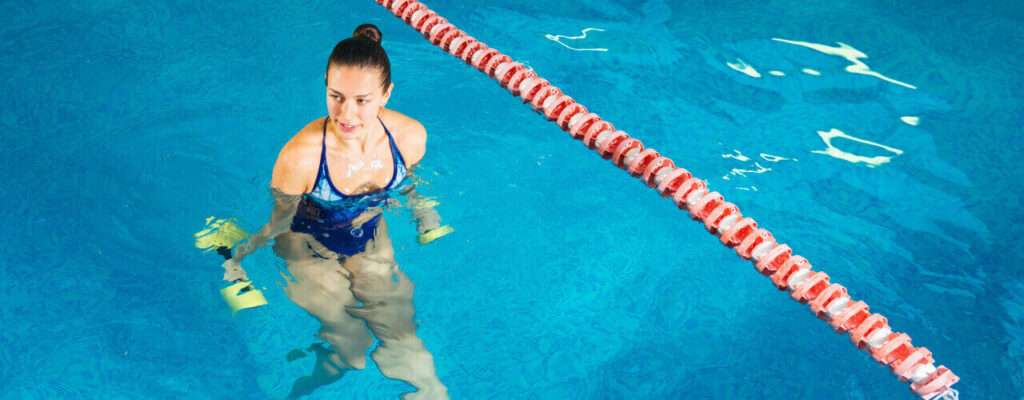
Joint pain has a way of shrinking your world. A morning walk becomes a negotiation. Getting up from a chair, climbing stairs: all of it requires calculation. And if you’re living with arthritis or recovering from surgery, you know exactly what I mean.
More people across North Wales are finding relief not through heavier medication or extended rest, but in a pool. Aquatic therapy (water-based therapeutic exercise) is changing how people manage joint pain, and at Total Performance Physical Therapy it’s become central to helping patients move better and live more fully.
What Is Aquatic Therapy?
Let’s clear something up: aquatic therapy isn’t swimming. No laps. No athletic ability required.
It’s structured, therapist-guided exercise in warm water, typically between 33°C and 36°C. That warmth is deliberate. It relaxes muscles, reduces stiffness, and makes movement feel possible again for people who’ve been struggling on land.
How It Works on Your Joints
Buoyancy takes the pressure off. Submerged to chest height, your body experiences roughly 80% less gravitational load. Joints under constant compression on land (knees, hips, spine) get a genuine break, and movements that feel impossible on solid ground become manageable in the pool.
Warm water eases stiffness. Heat increases blood flow to tissues and joints. For anyone dealing with morning stiffness from osteoarthritis or rheumatoid arthritis, this alone can be transformative.
Resistance builds strength without strain. Water resists movement in every direction, gently and consistently. This makes water therapy for joint pain ideal for strengthening muscles around vulnerable joints without impact risk. Stronger muscles protect your joints better. It’s that simple.
The Real Benefits
People going through aquatic therapy in North Wales often describe a shift that happens gradually, then suddenly.
First comes reduced pain, not zero pain necessarily, but enough to feel hopeful. Then better range of motion: shoulders rotating more freely, knees bending deeper. Strength and balance follow. And perhaps most importantly, confidence returns. People who’ve been afraid to move because movement has meant pain start trusting their bodies again.
That’s quality of life.
Conditions That Respond Well
Water therapy for arthritis is the most well-known application. Both osteoarthritis and rheumatoid arthritis respond well because warm water exercise tackles multiple problems at once: inflammation, stiffness, muscle weakness, and reduced mobility.
Aquatic therapy also helps with knee and hip pain (including pre- and post-replacement), chronic back pain, sports injuries, and post-surgical rehabilitation.
Ask any physiotherapist whether aquatic therapy is effective for arthritis pain and they’ll say yes. Patients report real reductions in pain and genuine improvements in how their joints function day to day.
What to Expect at Total Performance Physical Therapy
Before you ever step into the pool, you’ll sit down with a physiotherapist who actually listens. They want to understand what your mornings feel like, where things hurt, what you’ve already tried. That shapes everything that follows.
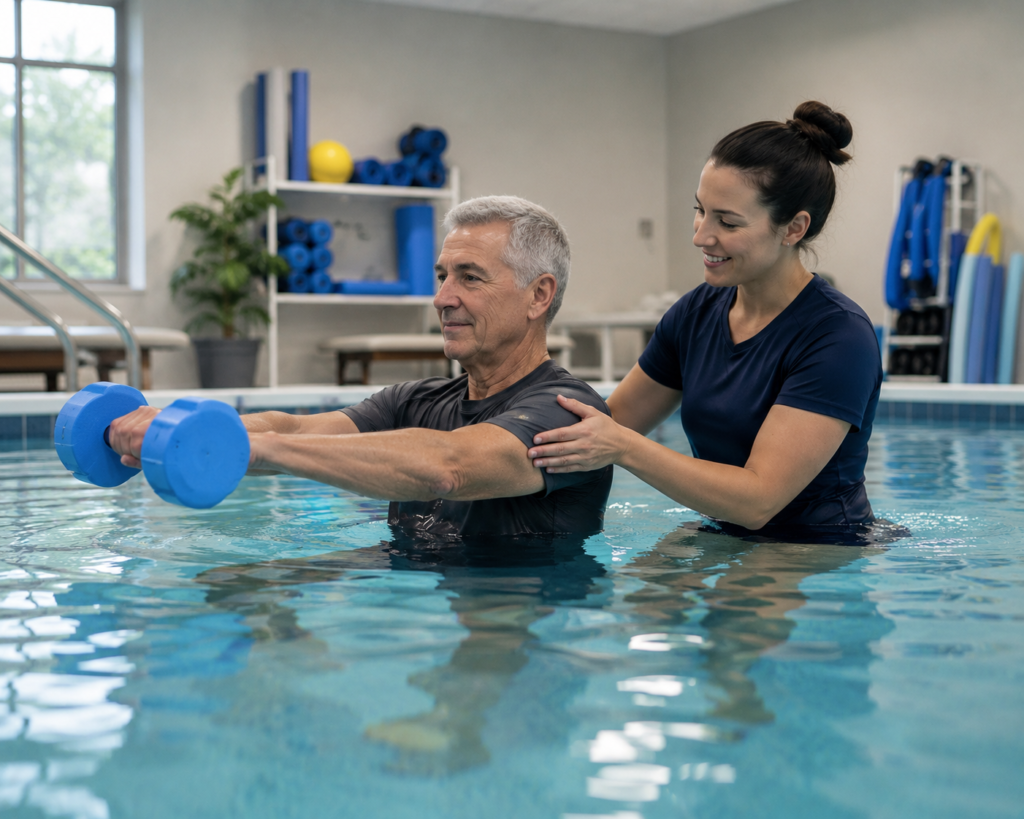
Your programme is built around you, not a template. In the pool, the therapist stays with you throughout, watching how you move, adjusting in real time, tracking progress week by week. Joint pain rehabilitation in North Wales done properly looks like this: someone in your corner, every session.
Aquatic therapy vs Traditional Physiotherapy
Neither is universally better. They work differently and often complement each other.
Land-based physiotherapy mimics daily activities well and is excellent once a patient can tolerate load. Aquatic therapy allows earlier intervention. When pain makes land-based exercise impossible, the pool is a safe starting point. For many patients, aquatic therapy North Wales is the bridge that gets them moving again so land-based rehab can follow.
Is It Right for You?
Most people with joint pain can benefit. It suits older adults, those with severe pain, and anyone post-surgery. Caution is needed in some cases, such as open wounds or certain infections, which is why an initial assessment matters. A physiotherapist will flag any concerns before you start.
Is aquatic therapy effective for arthritis pain in your specific situation? Have that conversation with a professional.
Why Total Performance Physical Therapy?
Lots of clinics offer aquatic therapy. Fewer treat it as a serious rehabilitation tool rather than a one-size-fits-all add-on. At Total Performance Physical Therapy, every session is supervised by someone who knows your case. The plan changes as you do. The goal isn’t getting you through a few pain-free weeks; it’s making sure your joints are stronger months from now. If you’re searching for joint pain rehabilitation in North Wales with that kind of commitment, this is the right place.
Conclusion
Joint pain doesn’t have to define your daily life. Get assessed early, get in the water, and give your joints the support they deserve.
Reach out to Total Performance Physical Therapy and take the first step.
FAQs
How does aquatic therapy help relieve joint pain? The warm water relaxes tight muscles and gets blood moving to stiff joints, while buoyancy means your body isn’t fighting gravity. That combination makes movement far easier, and moving is what starts the healing.
Is aquatic therapy effective for arthritis? For most people with osteoarthritis or rheumatoid arthritis, yes. Pain eases, movement improves, and the muscles supporting the joint get stronger. It won’t cure arthritis, but it makes a meaningful difference to daily life.
What happens during a session at Total Performance Physical Therapy? You’ll start with an assessment so your physiotherapist understands where you’re at. From there, you’ll work through exercises in the pool with them present the whole time. It’s one-to-one attention, and the exercises adjust as you improve.
How many sessions are usually needed? It depends. Some people notice a difference within three or four sessions. Others with more complex conditions need a longer programme. Your physiotherapist will give you a realistic picture after your first assessment.
Is aquatic therapy suitable for older adults? Often ideal for them. Water therapy for joint pain is gentle enough to start even when mobility is quite limited, and it builds gradually from there.