
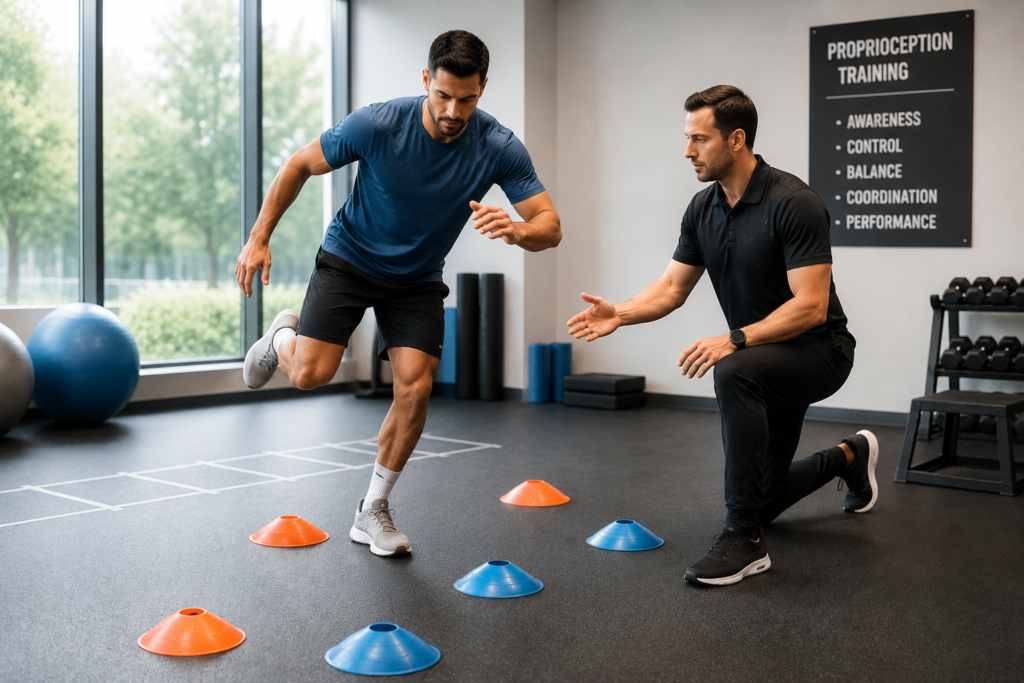
Most athletes focus on speed, strength, and endurance. Those things matter. But there is a less obvious quality that quietly determines how well all of them work together: the ability to sense and control where the body is in space. That is proprioception, and when it is well-developed, everything from cutting and landing to absorbing contact becomes more controlled, more efficient, and significantly less likely to result in injury.
At Total Performance Physical Therapy, balance and proprioception training is built into sports rehab and performance programs because athletes who train it move better, recover faster, and stay healthier longer.
What Proprioception Actually Is
Proprioception is the body’s internal position-sensing system. Receptors in the muscles, tendons, and joints constantly send signals to the brain about where each body part is and how quickly things are changing. The brain takes all of that in and fires back movement responses before conscious thought even gets involved.
A basketball player adjusting mid-air to land safely, a soccer player recovering balance after a tackle, a runner correcting stride on uneven ground. None of that is deliberate. It is the nervous system doing its job because it has been trained to. When proprioception is disrupted, usually after injury, movement becomes less precise and the body is slower to respond to instability. That is when re-injuries happen.
How Balance Training Improves Performance
Better balance is not just about not falling over. Direction changes become sharper. Reactions come faster. Movement patterns stop relying on compensation and start working the way they should. Sport-specific balance training at Total Performance Physical Therapy sports rehab services builds on all of that by matching the training environment to what each athlete actually faces in competition.
Why It Prevents Injuries
Sports injury prevention exercises that target proprioception are among the most evidence-backed interventions available. Ankle sprains, knee instability, and ACL injuries share a common thread: the neuromuscular system failed to respond quickly enough to an unexpected force or direction change.
Better landing mechanics reduce impact load on the knee. Improved cutting patterns reduce rotational stress on ligaments. Training under fatigue, when most sports injuries actually occur, builds the resilience that holds up when it matters most.
Physical therapy for ankle instability in North Wales focuses heavily on this. Ankle instability after an initial injury is often not structural. It is proprioceptive. The neuromuscular control that keeps the joint stable during dynamic movement was lost, and that is trainable.
Signs an Athlete May Need This Work
Frequent ankle rolling, poor balance during direction changes, repeated injuries to the same area, and hesitation before explosive movements all point to proprioceptive gaps. These are not signs of weakness. They are patterns that have not been specifically trained, and they respond well when they are.
What the Training Looks Like
Single-leg balance drills isolate stabilizing demand on one limb and progressively challenge it with added movement or unstable surfaces. It starts with single-leg work, moves into reactive drills where the athlete has to respond rather than predict, and builds toward movements that mirror what the sport actually demands.
The unpredictable elements are intentional. A partner push, a ball catch, a sudden direction cue. The nervous system needs to be surprised in training so it is not caught off guard in competition. Agility and footwork work ties it all together, connecting body awareness to the movements that actually show up in sport. Return-to-sport rehab in Harleysville at Total Performance Physical Therapy follows that same thread, making sure athletes cross back into competition genuinely prepared, not just cleared.
How Physical Therapy Puts It Together
Balance therapy in Hatfield starts with movement and stability assessments that identify where the gaps are. Neuromuscular retraining follows in a progressive sequence, from controlled low-demand tasks to sport-specific movement under realistic conditions. Strength and movement control are trained together because an athlete who is strong but cannot control that strength under instability is still vulnerable.
Return-to-sport rehab in Harleysville follows clear benchmarks so the decision to return to play is based on demonstrated readiness, not just how much time has passed. Balance therapy in Hatfield and Total Performance Physical Therapy sports rehab services are built around one principle: return when the system is ready, not just when it feels okay.
FAQs
How does proprioception training improve performance? The nervous system gets faster and more precise, showing up as sharper agility, cleaner coordination, and better control when things get unpredictable.
Can balance training prevent sports injuries? Consistently yes, especially for ankles, knees, and repeat injuries after returning to sport.
What are the best balance exercises for athletes? It starts with single-leg work, moves into reactive drills where the athlete has to respond rather than predict, and builds toward movements that mirror what the sport actually demands.
How often should athletes train proprioception? Two to three times a week works well for most, folded into existing training rather than treated as something separate.
Is proprioception training important after injury? It is one of the most important parts of rehab. Injury disrupts the proprioceptive system directly, and rebuilding it is essential for safe return to sport.