
Your back hurts. You’ve tried stretching, rest, maybe a new chair. Things improve for a week, then you’re back to square one. The conversation most people haven’t had yet is about their core.
This isn’t about aesthetics. It’s about the muscles quietly failing to do their job, and everything else in your body compensating as a result. At Total Performance Physical Therapy, physical therapy East Norriton patients regularly find that core stability is the missing piece they’d overlooked.
Understanding the Core
The core isn’t just your abs. It’s a group of muscles stabilising your spine and pelvis: the deep abdominals, the muscles along your back, your pelvic floor, and your diaphragm. They fire together milliseconds before you lift something, take a step, or reach overhead.
When they work well, you barely notice them. When they don’t, everything else compensates, and that’s usually when pain shows up.
Signs Your Core Needs Work
A weak core rarely announces itself directly. It shows up as something else.
Persistent lower back pain is one of the most common signs. Without adequate core stability, the spine absorbs load it shouldn’t. Poor posture is another: slumped shoulders, a forward head, an excessive arch in the lower back, all signs the muscles meant to hold you upright aren’t pulling their weight. Posture correction therapy East Norriton residents seek out is often the first step toward understanding why that keeps happening.
Balance problems are telling too. Unsteady on uneven ground, wobbly on one leg, picking up injuries more often than you’d expect: a weak core is frequently the common thread. Balance and mobility therapy East Norriton patients access through physical therapy addresses exactly these issues, often with results that show up quickly in daily life.
What Physical Therapy Actually Does for Core Strength
The difference between doing core exercises on your own and doing them through physical therapy is significant.
If certain muscles have switched off or never learned to activate properly, no amount of planking is going to fix that. A physio figures out what’s actually not working before prescribing anything. Functional strength training done this way has a completely different effect than the same exercises done blindly at home.
For people with back pain, posture problems, or post-surgical recovery needs, that precision is what gets lasting results. Generic workouts often reinforce the patterns that caused the problem in the first place.
Common Core Exercises Used in Physical Therapy
The exercises are often less dramatic than people expect, at least early on. That’s the point. Build deep stability before layering on load.
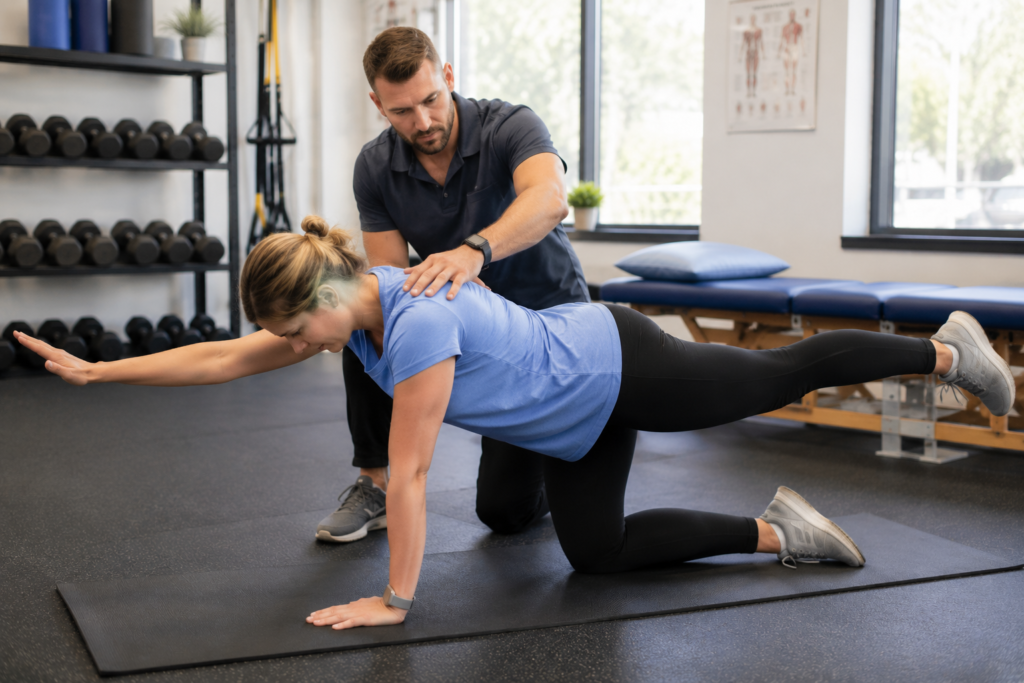
Bridges teach the glutes and lower back to work together without strain. Bird dogs challenge coordination and spinal control in a neutral position. Dead bugs look simple and are among the most effective exercises for training deep abdominals to stabilise the spine under movement.
Planks build endurance across the entire core rather than just surface muscles. As a patient progresses, functional strength training brings movements that replicate what the body actually needs to do: lifting, carrying, standing without discomfort.
What to Expect at Total Performance Physical Therapy
The first session isn’t exercise. It’s conversation and assessment. Where does it hurt, when did it start, what have you tried, how does your body actually move. That information shapes everything that follows.
Your programme gets built from scratch around what you need. Every session has someone watching how you move, catching compensations before they become habits. Core exercises done with poor form don’t just fail to help. They can reinforce the problems causing pain.
Progress is tracked and the programme changes as you do. Stronger this week means harder next week. It’s never just about the core in isolation either: posture, balance, and mobility are all part of the picture, especially for anyone coming back from a lower limb injury or finding stability has become more of a challenge with age.
Benefits That Extend Beyond the Clinic
People consistently report improvements in how they move day to day: carrying shopping without discomfort, sitting longer at a desk without the back tightening, getting off the floor more easily. The gains tend to stick because the root cause has been addressed rather than managed around.
Conclusion
A strong core isn’t a fitness goal. It’s a foundation for moving well, staying out of pain, and doing the things that matter without your body getting in the way.
The posture correction therapy East Norriton residents access at Total Performance Physical Therapy, the balance and mobility therapy East Norriton patients work through, the supervised core rehabilitation: it all connects. None of it is guesswork.
If back pain, poor posture, or balance issues have been slowing you down, it’s worth a conversation.
FAQs
How does physical therapy improve core strength? A physio works out which muscles have stopped doing their job and why, then builds a plan around that. It’s a different starting point than any generic core routine.
Can core strengthening help with lower back pain? For a lot of people, it’s the main thing that does. The lower back often hurts because it’s doing work the core should be handling. Address that imbalance and the pain usually follows.
What exercises are used for core strengthening in physical therapy? Bridges, bird dogs, dead bugs, and planks are common starting points. As you progress, functional strength training brings in movements that reflect what you actually do day to day.
How long does it take to strengthen your core through physical therapy? Four to eight weeks is a reasonable window for noticing real change, though it depends on where you’re starting and what you’re dealing with. Your physio will be honest with you about expectations.
Why choose Total Performance Physical Therapy for core strengthening in East Norriton? One therapist who knows your case, a programme built around you, and someone in the room making sure you’re doing it right. That’s harder to find than it should be.